What to Expect During a Channel Upgrade Program
Channel upgrade programs are complex, multi-stage projects. Here is what irrigators and contractors can expect — from specification through to commissioning — and how Milcast fits into the process.
Channel upgrade programs are among the most significant infrastructure investments an irrigation district or large irrigator can make. They are also among the most complex — involving multiple stakeholders, long lead times, and a construction program that has to work around the irrigation season.
Having supplied precast concrete products to channel upgrade programs across the Riverina for decades, Milcast has a clear picture of how these projects work and where things can go wrong. This guide is intended to help irrigators and contractors understand the process and plan accordingly.
The Phases of a Channel Upgrade
1. Assessment and Condition Survey
Most channel upgrade programs start with a condition survey — a systematic inspection of every structure in the channel system to assess its condition and remaining service life. This produces a prioritised list of structures for repair or replacement, which forms the basis of the upgrade program.
For large irrigation districts, this survey may cover hundreds or thousands of structures and take months to complete. The output is typically a database of structure conditions, with each structure classified by urgency — immediate replacement, replacement within five years, monitor and reassess, and so on.
2. Design and Specification
Once the scope of the upgrade is defined, the design and specification phase begins. For standard structures — bay outlets, drop boxes, headwalls — this typically involves selecting the appropriate product from a standard range and confirming that it suits the site conditions.
For non-standard applications — unusual channel geometries, high operating heads, special access requirements — a more detailed design process may be required. Milcast can provide technical input at this stage to help specify the right product and identify any non-standard requirements early.
Getting the specification right at the design stage is critical. Changes to the specification after products have been manufactured are expensive and time-consuming.
3. Procurement
With the specification confirmed, procurement can begin. For large programs involving many structures, procurement is typically done in batches — ordering the structures needed for each construction stage as the program progresses.
Lead times for standard Milcast products are typically short, but for large programs it is worth discussing your schedule with us early. We can plan production to match your construction program and avoid the situation where construction is ready to proceed but product is not available.
4. Construction
Channel upgrade construction is typically done during the off-season — when the channel is not carrying water. In the Riverina, this is usually the winter months, from May to September.
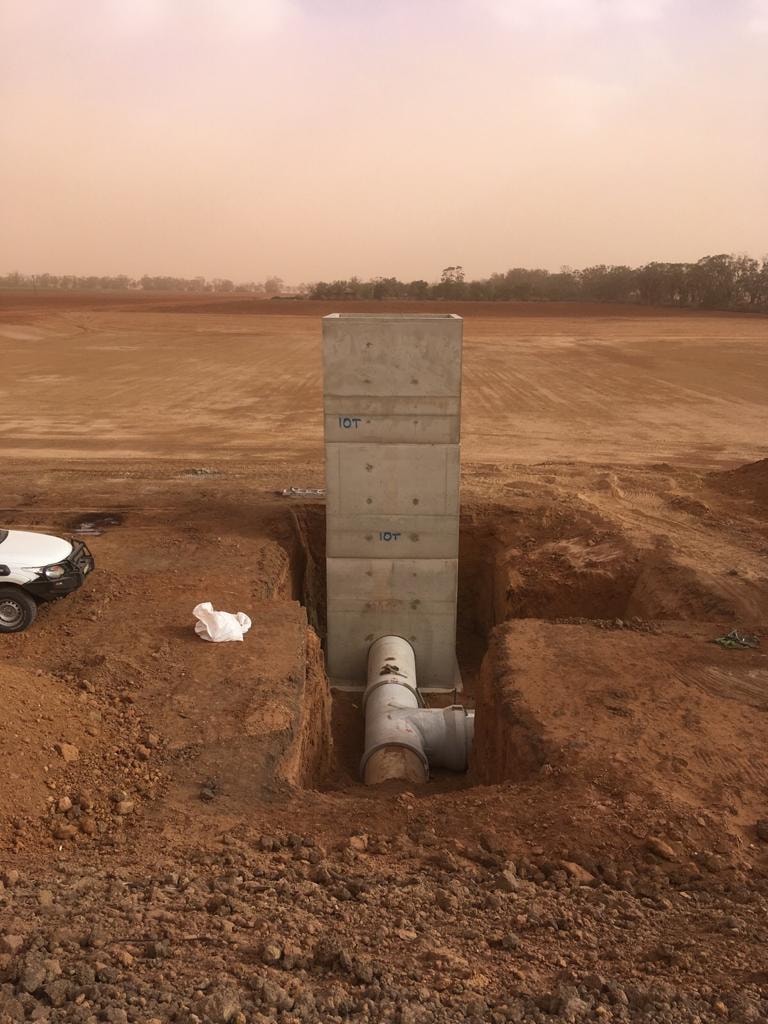
The construction sequence for a typical structure replacement is:
- Dewater the channel — the channel section is isolated and dewatered before work begins
- Excavate — the existing structure is excavated and removed
- Prepare the bed — the excavation is trimmed and a compacted bedding layer is placed
- Install the new structure — the precast structure is lifted into position and set to the correct level and alignment
- Backfill and compact — the excavation is backfilled in layers with compaction at each layer
- Reinstate the channel — the channel lining and banks are reinstated around the new structure
- Commission — the structure is tested before the channel is returned to service
The speed of this sequence depends on the size of the structure, the site conditions, and the experience of the construction crew. A standard bay outlet replacement can typically be completed in a day by an experienced crew; larger or more complex structures take longer.
5. Commissioning and Handover
Before a upgraded channel section is returned to service, the new structures are commissioned — gates are operated through their full range, water levels are checked, and any defects are identified and rectified.
For district channel systems, the irrigation district's engineering staff typically carry out or witness the commissioning. For on-farm works, the farmer or their contractor is responsible.
Common Causes of Delay
In our experience, the most common causes of delay in channel upgrade programs are:
Late specification changes. Changes to the product specification after manufacturing has started — or after product has been delivered to site — are expensive and time-consuming. Get the specification right before ordering.
Underestimating lead times for non-standard products. Standard products are typically available quickly. Non-standard products — custom sizes, special gate configurations, unusual materials — take longer. Identify non-standard requirements early and allow adequate lead time.
Poor site preparation. A precast structure can only be installed as quickly as the site is prepared. Delays in dewatering, excavation, or bedding preparation hold up the whole program. Plan site preparation carefully and have contingencies for unexpected conditions.
Weather. Winter construction in the Riverina can be disrupted by rain, frost, and flooding. Build contingency into your program for weather delays.
How Milcast Supports Channel Upgrade Programs
We work with irrigation districts and civil contractors at every stage of the channel upgrade process — from early specification advice through to delivery of product to site.
Our Finley location means we can respond quickly to changes in the construction program and supply product on short notice when needed. We maintain stock of the most common products and can schedule production of larger orders to match construction programs.
If you are planning a channel upgrade program and want to discuss product options, lead times, or technical specifications, contact our team in Finley on (03) 5888 3051.
Explore Topics
Written by
Milcast Team
Content creator and writer sharing insights and stories.


